
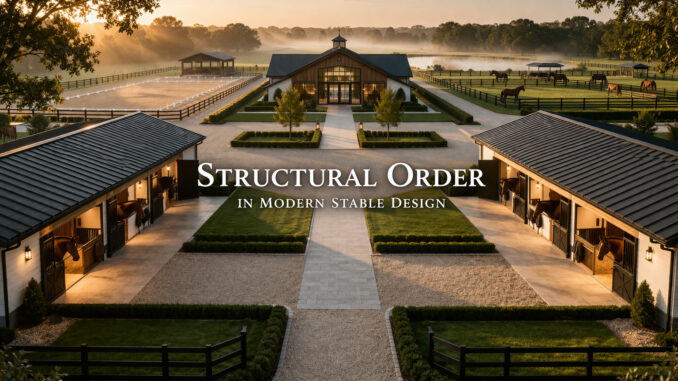
In equestrian environments, architecture is never neutral. The layout of a stable, the proportions of a barn, the positioning of paddocks, and the flow between training spaces all shape the behaviour of both horse and rider. Structural order is not simply an aesthetic consideration. It is a functional system that governs movement, reduces friction, and reinforces the discipline that defines serious sporting operations.
The most refined equestrian estates share a common quality: they feel intentional. Nothing appears accidental. From the alignment of stable blocks to the symmetry of walkways and the clarity of access points, each element contributes to an environment that supports calm, efficient routines. In this context, design is not decoration. It is infrastructure for performance.
The Logic of the Modern Stable
A well-designed stable operates as a system of controlled movement. Horses transition from stall to grooming area, from grooming area to arena, and from arena to turnout with minimal disruption. Clear sightlines reduce stress. Consistent spacing prevents congestion. Durable materials ensure longevity. These are not luxury features; they are the practical foundations of a professional environment.
Increasingly, high-end equestrian properties are borrowing principles from contemporary architecture. Clean lines, natural light, ventilation strategies, and material restraint are being prioritised over ornamental excess. The result is a new standard of barn design—one that reflects both operational efficiency and a refined visual language.
Order, Welfare, and Longevity
Structural order is inseparable from welfare. Poorly designed spaces create unnecessary stress points: narrow walkways, inadequate ventilation, inconsistent footing, and inefficient layouts all contribute to avoidable problems. By contrast, a stable built with clarity and balance in mind supports both physical health and behavioural stability.
This connection between design and welfare is well recognised in contemporary guidance. Publications from the American Association of Equine Practitioners note that improving air circulation and ventilation in barns helps reduce ammonia levels and can lower the transmission of respiratory and airborne pathogens. The AAEP’s biosecurity guidelines offer a more reliable authority reference here.
Architecture as Identity
Beyond function, structural order also defines identity. The world’s most recognisable equestrian properties are not distinguished solely by their horses or results, but by the environments they cultivate. A well-composed estate communicates standards immediately. It signals discipline, investment, and long-term thinking without the need for explanation.
This is where architecture and culture converge. A stable designed with precision tends to produce work of similar quality. A disordered environment rarely sustains excellence for long. In that sense, structural order is not an accessory to the sporting life. It is one of its primary conditions.