
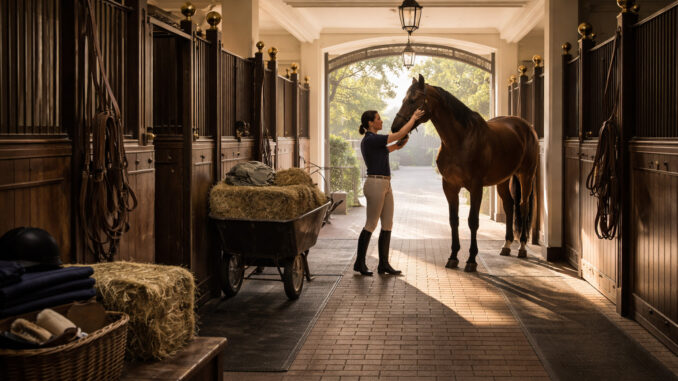
Serious horsemanship is built not in moments of spectacle, but in the quiet repetition of ordinary days. The daily routine of the stable has always been the invisible engine behind equestrian excellence. Feeding times, grooming rituals, turnout schedules, tack preparation, arena maintenance, cooling down, wrapping, walking, checking, cleaning, and beginning again: these small acts form the architecture of a disciplined sporting life. To the casual observer, they may appear mundane. To anyone who understands the stable world properly, they are the work itself.
This is why the best-run equestrian environments feel so composed. They are governed by systems. Horses thrive on consistency, and riders depend upon it more than they often admit. A well-ordered morning in the yard does more for performance than dramatic interventions ever can. Rhythm is not only something developed in the arena. It is established long before the first rein is taken up. The stable routine sets the tone for every movement that follows.
The Discipline Behind the Visible Work
In equestrian culture, standards are often judged by what is immediately visible: turnout, presentation, posture, polish, and results. But the visible standard is always downstream from an invisible one. Horses that look settled usually come from organised environments. Riders who appear calm under pressure are often supported by routines so familiar that they reduce unnecessary friction. Even elegance has a logistical foundation.
This is what distinguishes the serious stable from the performative one. The point is not simply to appear orderly. The point is to make order habitual. When every object has a place, every horse has a schedule, and every task is done with consistency, the atmosphere changes. The yard becomes quieter. The horses become steadier. The people become more exact. Good routines do not restrict excellence. They make it possible.
Welfare, Timing, and Stable Intelligence
Routine also has a welfare dimension that should never be underestimated. Horses are acutely responsive to changes in their environment, and inconsistency in feeding, turnout, exercise, or handling can quickly create avoidable tension. Good stable management is therefore not only a matter of efficiency, but of responsibility. Guidance from the British Horse Society consistently emphasises the importance of structured daily care, turnout, feeding, hydration, and observation in maintaining equine well-being. The BHS horse care and welfare guidance is a useful authority reference on the fundamentals that support this kind of management.
The most accomplished yards understand this intuitively. They do not confuse luxury with excess. They know that the most impressive stable is often the one in which everything runs on time, nothing is neglected, and the horses feel settled enough to do their work without anxiety. Good management rarely looks theatrical. It looks smooth.
Why Routine Still Defines Excellence
Modern sporting culture tends to celebrate intensity, but equestrian excellence is still shaped by steadiness. A single brilliant ride can impress. A year of well-managed mornings creates something far more valuable: confidence, soundness, and trust. Stable routine is not glamorous material, yet it remains one of the clearest dividing lines between ambition and seriousness.
In the end, the daily life of the yard is where sporting standards are either confirmed or exposed. It is where discipline becomes visible in its purest form. Not in applause, but in consistency. Not in display, but in practice. That is why the stable routine still deserves to be regarded as one of the central rituals of the equestrian life.