
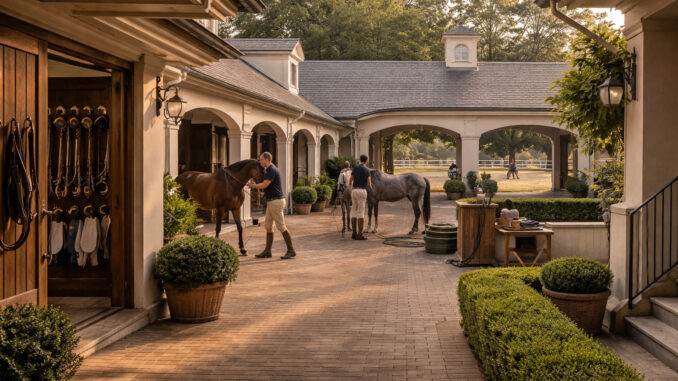
The best equestrian properties are designed not only for appearance, but for circulation. Movement through a stable environment is never random. Horses move from stall to grooming bay, from grooming bay to wash area, from wash area to turnout, and from turnout back into the training system. Staff move continuously between feed rooms, tack rooms, utility spaces, storage zones, and service points. Riders move between preparation, schooling, observation, and recovery. When this flow is interrupted by poor design, the entire rhythm of the property begins to suffer.
This is why circulation planning deserves greater attention within conversations about modern stable design. It determines whether a yard feels calm or congested, intuitive or awkward, efficient or unnecessarily theatrical. A beautiful building can still fail operationally if it ignores how horses and people actually move through space. By contrast, a well-planned property often feels impressive precisely because its logic is so unobtrusive. Nothing snags. Nothing bottlenecks. Nothing feels more complicated than it needs to be.
Designing for Calm Movement
Horses are highly sensitive to pressure, noise, sudden proximity, and unclear pathways. A stable that asks them to negotiate tight turns, narrow passages, poor sightlines, or conflicting traffic patterns creates unnecessary stress before any training begins. Thoughtful circulation planning reduces those stress points. Wider aisles, clearly separated functions, predictable routes, and visible transitions between zones all help create a quieter, more manageable environment.
This applies equally to human experience. Staff efficiency is shaped by repetition, and repetition is shaped by layout. When feed is stored logically, equipment is placed where it is actually needed, and service routes do not conflict with horse movement, the yard becomes smoother without becoming sterile. Operational elegance is one of the most underrated luxuries in modern estate design.
Separation of Zones
One hallmark of a well-ordered property is the separation of functions without fragmentation. Riding arenas, stable blocks, wash bays, staff areas, tack rooms, forage storage, manure management, and turnout access each require proximity, but not confusion. The strongest layouts understand that adjacency and separation must be balanced carefully. A tack room should feel central to use, but sheltered from chaos. A grooming bay should feel connected, but not obstructive. Turnout access should feel direct, but safe.
Circulation, in its simplest form, is about how movement is guided and controlled within a space. In equestrian environments, this principle becomes especially important. Every pathway, doorway, and transition point contributes to the overall experience of the yard, shaping both efficiency and atmosphere.
Why Flow Is a Mark of Serious Design
What distinguishes serious stable design is often not ornament, but flow. The rider may not consciously admire the width of a passage or the positioning of a gate, yet those decisions affect the atmosphere of the entire property. Good flow creates confidence. It reduces noise, saves time, lowers friction, and allows both horses and people to settle into the work more naturally.
For that reason, circulation planning should be regarded as one of the quiet foundations of equestrian architecture. It sits beneath the visible elegance of the property, but it is often the difference between a place that merely photographs well and one that truly works. Order is not only what the eye sees. It is what movement confirms.