
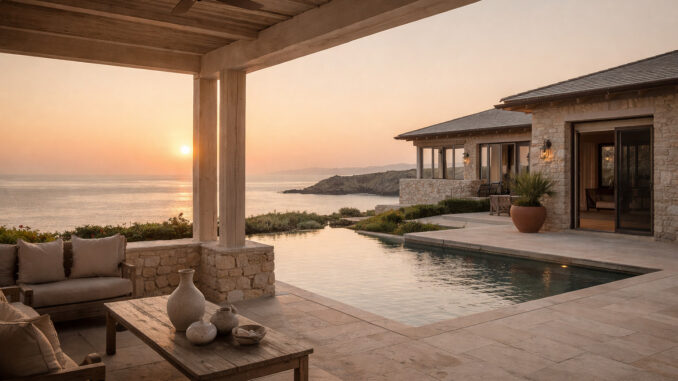
Coastal properties are often judged first by their view, but the most enduring ones are defined by what cannot be seen immediately. Behind every successful shoreline retreat lies a careful negotiation with climate, materials, and exposure. Salt air corrodes. Sunlight fades. Wind shifts constantly. Moisture accumulates in ways that inland properties rarely experience. The coastal environment is not passive. It is active, and it tests every decision made in design and construction.
This is why material selection becomes one of the most important considerations in coastal architecture. Timber must be treated or chosen for resilience. Metals must resist corrosion or be allowed to age deliberately. Stone must hold structure without becoming brittle. Even paint systems and finishes must be selected with long-term exposure in mind. A property that appears effortless by the sea is almost always the result of highly deliberate technical choices.
Designing for Exposure
Exposure is not simply a problem to solve. It is a condition to design around. Open terraces, shaded walkways, overhangs, and transitional indoor-outdoor spaces all help manage the intensity of coastal environments. Proper orientation reduces heat gain. Cross-ventilation improves comfort without mechanical dependence. Covered circulation routes allow movement without interruption from weather. These elements, when executed correctly, create a sense of ease that feels natural but is in fact carefully engineered.
The most refined coastal properties rarely overbuild. Instead, they edit. They remove what is unnecessary and focus on proportion, airflow, and material honesty. This restraint allows the environment to remain present without overwhelming the structure itself. It also ensures that the property can endure over time without constant correction.
The Patina of Coastal Living
One of the defining characteristics of coastal architecture is its relationship with ageing. Unlike urban environments that often aim to preserve surfaces in perfect condition, coastal properties tend to develop a patina. Timber softens in tone. Metals weather. Stone takes on subtle variation. This process, when anticipated correctly, enhances rather than diminishes the character of a place.
The key distinction lies in whether ageing has been considered from the outset. A well-designed coastal property ages with dignity because it was designed to do so. A poorly considered one deteriorates visibly because it resists the environment rather than working with it. The archive is therefore less interested in perfection than in permanence.
Why Materials Define the Experience
Materials shape more than durability. They influence atmosphere. A shaded stone terrace underfoot, a timber ceiling overhead, linen textures in open air, filtered light through architectural openings—these details determine how a place feels as much as how it performs. In coastal settings especially, sensory experience becomes inseparable from design.
That is why the most memorable coastal properties are rarely the most elaborate. They are the most resolved. They understand their conditions, respond to them intelligently, and allow materials to carry the weight of expression. In doing so, they achieve something rare: a balance between exposure and control that feels both effortless and enduring.