
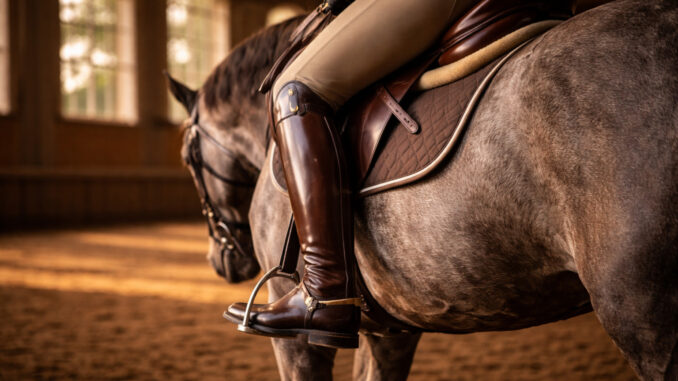
Few garments carry the same quiet authority as the riding boot. Within equestrian culture, boots are never a minor detail. They shape posture, influence presentation, and reflect the broader discipline of the sporting wardrobe. A polished field boot or dress boot does more than complete an outfit. It signals readiness. It implies structure. It frames the rider within a tradition that values order, proportion, and function above display.
This is why boots remain one of the clearest expressions of equestrian style. Unlike trend-driven fashion pieces, they are judged by performance first. Fit through the calf, support through the ankle, balance in the foot, suppleness of the leather, and the way the boot settles over time all matter far more than novelty. A beautiful boot that fails in the saddle is meaningless. In the sporting world, elegance must always answer to utility.
Form, Function, and Tradition
Riding boots evolved from practical requirements. They were designed to protect the rider’s leg, improve stability, and create a smooth interface with saddle and horse. Over time, that practical object became one of the defining silhouettes of the equestrian world. The relationship between boot design and mounted culture is part of a much older history of riding boots, where form and function developed together rather than separately.
What makes the riding boot especially compelling is the way it bridges utility and ritual. It belongs equally to work and ceremony. It can endure mud, weather, early mornings, and repetitive use, yet still look completely at home in the formal atmosphere of the ring. That duality helps explain why it remains so influential, both within equestrian settings and beyond them.
Why Craft Still Matters
A good riding boot improves with wear. The leather softens without collapsing. The shaft begins to shape itself to the rider. Creases settle into place with dignity rather than disorder. This process is one of the reasons equestrian dress remains so resistant to disposable fashion. The best items are not consumed quickly. They are broken in, maintained, repaired, polished, and carried forward.
Craft matters because the boot is subjected to real demands. It must tolerate repetition without losing structure. It must remain elegant while being used in practical conditions. Cheap imitation is exposed quickly in such an environment. Serious riders tend to understand this instinctively. They are rarely interested in excess for its own sake. They want articles that hold their line.
The Sporting Wardrobe’s Clearest Symbol
If the sporting wardrobe is defined by restraint, then the riding boot may be its clearest symbol. It is formal without being fragile, traditional without being obsolete, and expressive without ever becoming loud. It belongs to a world in which standards are communicated through care rather than ornament.
That is why the riding boot continues to endure while so many other style signals fade. It remains grounded in use, shaped by history, and refined by discipline. In the end, it represents exactly what the sporting wardrobe values most: utility elevated through craft, and elegance earned through purpose.